Showing posts with label Environmental Portraits. Show all posts
Thursday, March 14, 2013
Robin Hammond: Condemned Mental Patients of Africa
Images of war and conflict have helped sway the opinion of people towards acting for the benefit of the victimized groups. In today's world however, the prevalence of war photographs has become so commonplace that most viewers have become desensitized to these images. This is saddening since a lot suffering still happens even years after armed conflict has passed. In his series entitled "Condemned", Robin Hammond gives a different perspective as a he exposes the cruel treatment of mental patients of Africa.
Robin Hammond is a photojournalist who has worked on human rights issues focusing on East Africa. He had previously traveled to Zimbabwe to document the extreme poverty of mostly everybody there. In the few short months he was in the country, Hammond was imprisoned two times and then deported. While the affair shocked him, he went back to the East Africa for another mission which he discovered serendipitously.
Hammond began his work on the condemned psychological victims when traveled to South Sudan to document the birth of the young nation. During one of his trips, he visited Juba Central Prison. There, he encountered mentally ill patients suffering from the trauma of prolonged war and who were now being neglected for lack of trained medical personnel and proper facilities. It was then that Hammond decided that his mission was to document the condemned mental patients of the region.
According to the World Health Organization, 1 in 3 Somali citizens suffer some form of psychological illness, born out of the years of war, famine and rape. The period of violence and desolation is so long, that an entire generation of Somalis have been born knowing only conflict and suffering. Similar stories can be found in the other neighboring countries of South Sudan, Kenya, Uganda, and Congo. When Hammond visited these places, he found men and women who had either lost lost loved ones to armed conflict, or were victims themselves of violence.
While the physical manifestations of war were easy to see, the mental toll was somewhat harder to document. This was because most mentally ill citizens were locked away from the public. Hammond recounts one of his visits to these victims: "Stepping into Juba Central Prison was like stepping into some kind of Hell. The heat, the stench, and here are these men, many chained to the floor, some naked and covered in flies and excrement... unfortunately, I would discover that this was not a unique case."
The default solution to the physiologically imbalanced is to chain them up and lock them away. For those still living outside of these prisons, they are tied up to a stick or post, and left their for years and years. In other areas, people resort to religious leaders to cure their family members. These healers use prayer and herbal medicines to treat patients, although many are also chained up during the process. For most families with mentally disturbed children, the only options are to lock them away in make-shift hospitals, hide them from the public, or simply abandon them.
Hammond's photographs reveal the cruel toll of war years after the fact, but his images only cover East Africa. In the next few years, the photographer is looking to expand his documentary to West Africa, specifically CƓte d'Ivoire, Chad, the Central African Republic, and Nigeria. In order to fund his project, Hammond is requesting the public to help cover his expenses (pledges can be made here). In doing so, Hammond hopes to increase awareness of the vulnerable people in these countries, which will hopefully lead to positive action.
This is Robin Hammond's website. Those who would like to help fund his continuing reportage of the condemned mental patients of Africa can do so here. He currently has one publication on his previous project entitled Robin Hammond: Zimbabwe: Your Wounds Will Be Named Silence.
Wednesday, February 20, 2013
The 2013 World Press Photo Winners
Two years ago, it was a haunting picture of an Afghan teenager who had had her ears and nose cut off. Last year it was a portrait of a Yemeni mother clutching her son in the style of La Pieta. This year, it's a dramatic burial march of two Palestinian toddlers. These are the 2013 World Press Photo Winners.
The World Press Photo Contest is an annual international competition that attracts photographers from different fields and backgrounds. The contest aims to encourage the highest standards of journalism, and provide a platform for the public to view the best documentary photographs for each year. This year the jury received 103,481 entries from 5,666 photographers of 124 different nationalities in order to find the best of the best.
The 2013 competition featured a few different categories from the previous years, with two winners per category, one for Story Entries (photo essays) and Single Entries. These categories are Contemporary Issues, Observed Portraits, Staged Portraits, Daily Life, Sports Action, General News, Sports Feature, Nature, and Spot News. A World Press Photo of the Year is also awarded to the best image from any category.
The award for 2013 World Press Photo of the Year went to Paul Hansen for his Gaza Image photograph (header image above) showing two young children who died from Israeli air strikes in the Palestinian Territories being prepared for their graves. Hansen also won the 1st prize in the singles section of the Spot News Category.
For Contemporary Issues, Maika Elan won 1st Prize Stories for "The Pink Choice" featuring gay and lesbian couples in the conservative society of Vietnam. Micah Albert won 1st prize singles for 1st Prize Singles for "At The Dandora Dump" showing a trash picker taking a break by reading a discarded book. In the Observed Portraits section, Ebrahim Noroozi took 1st Prize in Stories for "Victims of Forced Love", a story of an Iranian mother and son physically and emotionally scarred by an acid attack. Nemanja Pancic got the 1st Prize in Singles for "Little Survivor", a portrait of a newly orphaned young toddler.
In Staged Portraits, Stephan Vanfleteren earned the 1st Prize Stories for "People of Mercy", a series on Guinean people with different illnesses. Daniel Kaluuya won 1st Prize Singles for his portrait of actor Nadav Kander. In Daily Life, 1st Prize Stories went to Fausto Podavini for "Mirella", a 71-year old devoted wife to a husband stricken with Alzheimer's Disease. 1st Prize Singles was awarded to Daniel Rodrigues for "Football in Guinea-Bissau", a game being played on bare, dusty earth.
Sports Action 1st Prize Stories went to Roman Vondrous for "Cross Country Steeplechase", one of the most demanding races in the Czech Republic. 1st Prize Singles was earned by Wei Seng Chen for "Joy at the End of the Run", showing the final moment of a dangerous bull race. In General News, Alessio Romenzi got 1st Prize Stories for "Syria Under Siege", a photo story on how ordinary citizens are being affected by the current conflict in the country. Rodrigo Abd won 1st Prize Singles for "Aida", another victim in the syrian War.
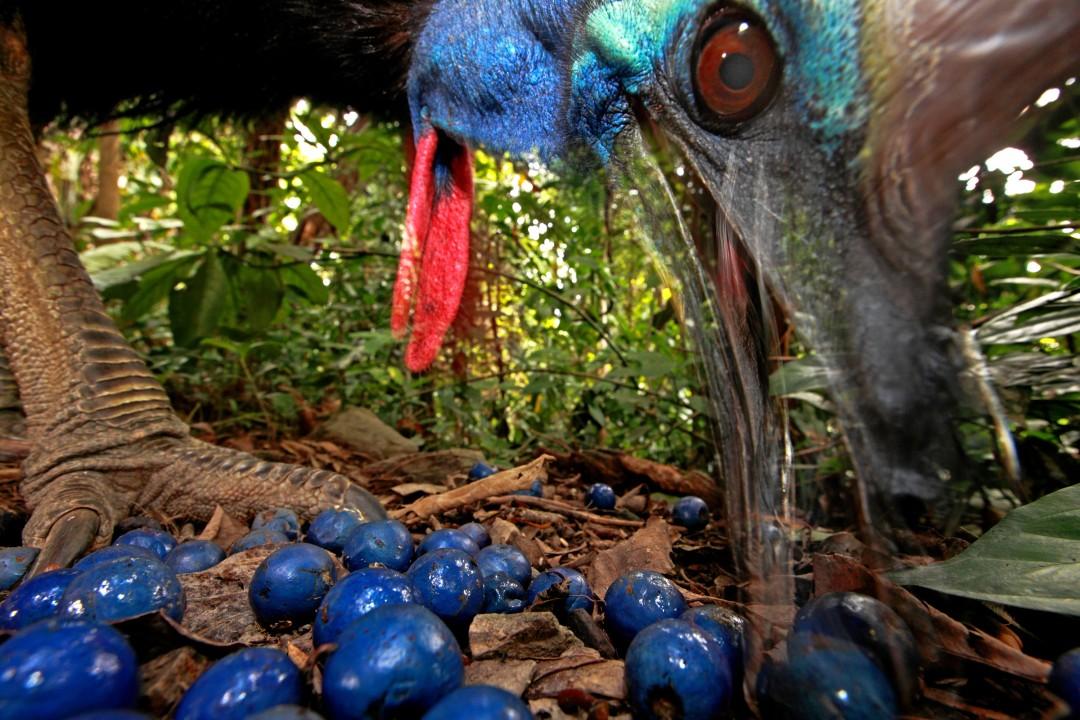
For Sports Feature, 1st Prize went to Jan Grarup for "I Just Want to Dunk", documenting a group of young Somali women and their passion for basketball despite the dangers of civil unrest. For Nature, Paul Nicklen got the 1st Prize Stories for "Emperor Penguins", the curious group of birds living in the Antarctic. Christian Ziegler earned 1st Place Singles for "Southern Cassowary", a different kind of rare bird feeding of a fruit tree. In Spot News, 1st Prize Stories went to Bernat Armangue for "Gaza", a series looking back at the growing tensions between Israel and Palestine.
The full gallery of images from the 2013 World Press Photo Winners can be found on the World Press Photo website. For previous winners, have a look at the World Press Photo 2012 Winners, as well as Jodi Bieber and the Other Afghan Girl.
Thursday, January 10, 2013
The National Geographic Photo Contest 2012 Winners
With the new year comes the chance to recap the best entries of the previous year. National Geographic, one the leading publications in photojournalism, continues to encourage the tradition of excellence in professionals and amateur photographers alike with its photography competitions. Here are National Geographic Photo Contest 2012 winners.
This year saw the National Geographic Photo Contest 2012 accept some 22,000 entries from 150 countries, from beginners to professionals, all hoping to be recognized in at least one of these three categories: People, Places and Nature. Each of these categories had a winner, with honorable mentions included. A Grand Prize Winner was selected out of all of the categories and entries combined. A Viewers' Choice was also selected for each of category. Overall, there were 13 top photographs selected by the judges.
The winners of the Places category were Nenad Saljic, Indra Swari Wonowidjojo, and Adam Coish. The People category winners included Micah Albert, Wendell Phillips, Ulrich Lambert, Kwan Ka Shing, and Kai-Otto Melau. The Nature category winners were Ashley Vincent, Fransisca Harlijanto, Jason Ching, Eric Guth, Micheal Eastman, and Sanjeev Bhor, with the Grand Prize going to Ashley Vincent.
There was some controversy this year as one of the original winners, Harry Fisch, was disqualified shortly after he was informed of his winning entry. After mailing the contest organizers a copy of his original photograph, his entry was disqualified as it seemed he had edited the photo against the rules of the competition.
Fisch had edited out a small plastic bag in a scene he captured in Varanasi, India. Unfortunately, the competition rules state that "only minor burning, dodging and/or color correction is acceptable", and Fisch's edit was considered a major image edit. This just goes to show how even a small edit can affect even the best entries into a photo contest.
The full gallery of the National Geographic Photo Contest 2012 winners can be found here. For a very related photo contest, check out the winning entries to the National Geographic Traveler Photo Contest 2012.
Sunday, October 7, 2012
The Kodak Colorama: The Biggest Kodak Moments of All Time
In its heyday, the Eastman Kodak company dominated the North American photography so much that its signature phrase "Kodak Moment" became a popular tagline for any moment worth photographing. Sadly, with Kodak filing for bankruptcy and planning to sell of many of its divisions, those days are long gone. However, thanks to the company's passion for visual excellence, many of the best Kodak Moments are preserved in large format images. In the middle of the last century, Kodak presented its Kodak Colorama, touted as the biggest photographs of its generation and certainly some of the best Kodak Moments of all time.
The Kodak Colorama were a collection of 18 feet high by 60 feet long color photographs that were displayed in the interior of Grand Central Station from the 1950s to the 1980s. The long strips of vivid color images depicted scenes of Americana reminiscent of Norman Rockwell's paintings, from Thanksgiving dinners to poolside parties to cowboys in the Grand Tetons. In the span of 40 years, over 500 Coloramas were displayed in the station's balconies.
The Colorama's story began in 1950 when Kodak was invited to advertise their products in Grand Central's east balcony. Because of the size of the area presented to them, the company's executives though it would be best to go with really large images covering the span of the balcony. The extreme size of these Coloramas demanded new photographic and processing techniques: a custom-built enlarger was made for the project, and the first few Coloramas required 450 feet of film. The ambient light was also a problem; because of the low light levels inside the station, the images were printed on special transparencies which were then illuminated from behind, not unlike the effect from stained-glass windows in churches and cathedrals.
The first few Coloramas centered around the theme of rebirth and rebuilding. The US had emerged from World War II only a few years before, and so Kodak photographers played on the themes of the American family and the golden age of the 1950s. While the scenes were majestically staged, they also had to convey a photographic message, specifically that ordinary people with small Kodak cameras could take the same shot. Thus, the familiar Americana and family theme remained a popular one all throughout the decades.
Because of the Colorama's unusual format, special cameras were used to make the images. The first photographs were made with old 8 x 10 large format cameras which were bulky and cumbersome to carry and operate. In later Coloramas, photographers had to work around the large format cameras they had with them, whether it was a scene in an ordinary living room, or underwater in the seas of St. Croix. It was only in 1986 when technology had improved enough that a Colorama was made from an ordinary 35mm camera.
As the decades came and went, subjects outside of the Americana theme were used and locations around the world (especially around famous tourist spots) became a popular Colorama theme. As the 1980s rolled in, technological advancements and consumer familiarity meant that the once majestic Coloramas became less and less impressive, and ordinary people thought of them as overwrought and even gaudy. The last Colorama was taken down in 1990.
While the primary intent of the Coloramas was to advertise Kodak's film and cameras, they became a visual record of what most people thought of as the ideal life worth photographing. Indeed, looking back at these images, it becomes clear that Kodak wasn't just selling cameras, but touting its vision of the American Dream.
For the past few months, the New York Transit Museum has been exhibiting the a selection of Colorama images as part of George Eastman House International Museum of Photography and Film's larger international exhibition. The images are currently on display until November 1st.
There's a lot more images and information on the Kodak Colorama e-magazine. This 30-minute documentary describes the entire era quite well. There's more old-school Kodak moments in this feature on Kodachrome. The large-format collection is published in Colorama: The World's Largest Photographs with more Kodak color goodness in Bound for Glory: America in Color 1939-43 and Americans in Kodachrome 1945-1965.
Tuesday, October 2, 2012
JeongMee Yoon: Boys versus Girls, The Pink & Blue Project
"Blue is for boys and pink is for girls". That statement has been so subconsciously ingrained into the minds of practically everyone in the first world that it seems silly to challenge it. Indeed, the differences in gender with boys versus girls and blue versus pink has become an accepted fact that manufacturers nowadays will automatically assign blue products to guys and pink products to gals. Artist JeongMee Yoon wanted to document this phenomenon in children and, along the way, uncovered some surprising historical facts in her Pink & Blue Project.
JeongMee Yoon studied Fine Arts and Photographic Design in South Korea and later moved to the US to further her career. Her first project as a solo artist was "Zoo", a series of black-and-white photographs that depicted urban animal habitats as dreary prisons rather than happy weekend leisure centers. Her next solo exhibition was the "Natural History Museum", a portrait collection of taxidermy wild animals in artificial settings.
Her most famous collection by far is the Pink & Blue Project, an ongoing series that began in 2005 focusing on the color preferences of different genders. In each image, an entire room is covered with a child's toys, clothes and other belongings in one dominant shade: blue for boys and pink for girls.
Yoon was inspired by her daughter who had a burning passion for everything pink; all her significant belongings from toys to clothes to school supplies were pink. Her daughter's portrait consisted of the younger Yoon sitting amidst all of her belongings in the middle of her room which suddenly looked like it was spray-painted with everything pink.
That first image became the start of the Pink Project, a portrait series on girls and their affinity for pink objects. She advertised her project around her neighborhood and her daughter's school, and soon found herself taking images remarkably similar to her first image in the collection. She soon added the Blue Project for boys and their belongings in blue. The two collections then merged into the Pink & Blue Project.
It's interesting to see the "gender wars" play out in children as young as a few months old and how it manifests itself in their belongings. Girls have pink dolls and pink dresses while boys have blue monster truck toys and bicycle helmets. It seems like a foregone conclusion that "blue equals boys" and "pink equals girls", but this wasn't always the case. Yoon's own research shows that pink was once the "natural" color for young men.
In the early years of the last century, many European countries assigned pink to their boys, and America felt strongly that boys should wear pink and girls should go with blue, "...the reason is that pink, being a more decided and stronger color, is more suitable for the boy, while blue, which is more delicate and dainty, is prettier for the girl.”
It was only after World War II that pink became strongly associated with women and therefore blue became the shade for men. Over 50 years later, Yoon's images show just how much two colors can define the identity of a person, and how much society has accepted this fact in the consumerism evident in these photographs.
JeongMee Yoon's website is here, with the Pink & Blue Project (aka boys versus girls collection), here. For an interesting look at one photographer's view on women, check out Shirin Aliabadi's Miss Hybrid. For a different take on men, have a look at Herb Ritt's portraiture.
Saturday, September 29, 2012
The Original Construction Guys: Lunch Atop A Skyscraper
Brian Finke's portrait series of construction workers is the perfect glimpse into the trade as it continues to evolve in the 21st century, but when someone talks about "construction" one particular image almost always comes to mind. This picture depicts the nonchalance of a group of construction guys set against vitality of a growing urban landscape and has forever been associated with 20th century New York City. This is the 1932 photograph "Lunch atop a Skyscraper".
"Lunch atop a Skyscraper", otherwise known as "New York Construction Workers Lunching on a Crossbeam", shows a crew of construction workers sitting in a row on a girder hundreds of feet above the ground without any other kind of support. The men are talking and smoking while taking out their lunch boxes and generally not paying any special attention to the unusual setting of their lunch break. The relaxed state of the construction workers paired with the exciting backdrop of New York City hundred of feet below them has captivated viewers ever since it was first popularized.
For many years, the photographer was unknown until evidence was presented around 2001 pointing to photojournalist Charles Ebbets as the author of the image. Unfortunately, new information has recently surfaced showing that the picture wasn't a spur of the moment image, but rather a planned publicity stunt involving many other photographers. While Ebbets was certainly one of the photographers involved with the event, it's hard to conclusively say that this particular photograph is his.
This Petapixel article has a good rundown of the iconic Lunch Atop A Skyscraper image including the recent confusion with regards to its authorship. There's also a new documentary entitled "Men At Lunch" that concerns itself with the photograph and how it's affected popular media today. You can check out the trailer below.
Wednesday, September 26, 2012
Brian Finke: Construction Guys
Photography has always been a wonderful way of revealing everything and nothing, from the majestic landscapes of Yosemite National Park to the hidden faces of plants and flowers. Sometimes it reveals the mystery of deep water creatures, other times it showcases something that's always been in every household. In this case, photographer Brian Finke shows something new in people that have always been part of the urban landscape in his project "Construction".
Since graduating with a Fine Arts degree, Brian Finke has worked for different publications including GQ, ESPN (Magazine), The New York Times and Rolling Stone, to name a few. He has exhibited and lectured extensively on his work, most notably on his previous projects on flight attendants, bodybuilders, and cheerleaders and football players.
In 2-4-6-8: American Cheerleaders and Football Players, Finke looks at the energetic Americana that is high school football and the female equivalent of cheer-leading. In Most Muscular, the muscular layers of bodybuilders are peeled away to reveal... even more muscle. In Flight Attendants, the photographer reveals a behind-the-scenes perspective of the decades-old profession. With his latest work, Construction, Finke once again turns his camera to a particular group of people; the blue-collared worker.
In Construction, Finke exhibits the same quality of portraiture found in his previous titles; tell-tale moments of individuals that capture the spirit of the larger group. Here, men and women don the stereotypical work clothes of construction workers and work in the stereotypical construction setting using stereotypical construction tools and machinery. The scenes are so vivid that one can almost smell the steel and stone being burnt, bent and hammered into place.
From high-rise condominium projects set against the skyline of a city to backhoes grinding against the dirt, there's really nothing new in Finke's collection, yet everything looks new. While Finke wanted to capture the energy and vitality of the construction boom that started in 2008, he instead got "...an honest look at what it means to be, at the daily task of being, a construction worker.”
With his Construction, Finke joins the pantheon of other notable photographers who documented manual labor: Lewis Hine and his stirring series on child labor which changed the labor laws of the US for the better, Irving Penn and his portraits of small-trade workers in Paris, and Sebastião Salgado and his somber look at today's manual laborers.
The vivid colors of these photographs are also reminiscent of the brilliant 1940s Kodachrome images of the Farm Security Administration - Office of War Information which showed the construction of tanks and planes to be used for World War II. Indeed, Finke's construction series is no more than small moments captured beautifully on film, but that in itself is worth sharing: honest moments preserved for posterity.
Brian Finke's website is here, with images from his past projects. The Construction series is due to be released soon in hard copy form as well as on in his website, but in the meantime, check out his previous works on Flight Attendants and 2-4-6-8: American Cheerleaders and Football Players.
Subscribe to:
Posts (Atom)