Pages

Showing posts with label Animal Photography. Show all posts

Thursday, March 7, 2013

Tamara Staples: The Chicken Fancy and Pretty Birds


Portrait photographers such as Yousuf Karsh and Annie Leibovitz are famed for bringing out that extra spark out of an otherwise ordinary subject. Many aspiring portraitists today follow their example in trying to coax out a little bit more out of their subjects. Fortunately for Tamara Staples, her subjects already look glamorous  The only thing need in her portrait series was the patience and passion to get all participants in one book. These pretty birds are the subjects of the chicken fancy in her book, The Magnificent Chicken.


Tamara Staples is a professional photographer known for her regal portraits of chicken. Her fascination for the domesticated farm bird began when she was a child visiting her uncle's poultry farm. Many of these visits would involve long conversations about chicken, and on one occasion, her uncle invited her to a poultry show. After her first experience with cacophony of sights, sounds and smells, Staples was hooked on the chicken.

Staples' subjects were the pets and owners of the chicken fancy, a hobby involving the breeding and raising of special breeds of poultry. Just like dog shows and similar events, there are also poultry shows which gather these hobbyists and their birds to show off their lovely plumage.


The governing body which organizes these events is the American Poultry Association established in 1873, and their basis for judging the best of the best is the American Standard of Perfection, a reference book which has been regularly updated since 1874. Every bird is judged on a 100 point scale, with no ambiguity left about any feature the chicken might have.

The exacting demands of the standards might make it seem that the breeders are overly competitive, but Staples only has nice things to say about the poultry owners. Each poultry show is indeed a competition, but fancy hobbyists spend more of their time discussing common points of interest rather than keeping secrets about their breeding strategies.


Staples' first portrait attempts were simple pictures she took during her free time. Slowly, she would learn from each shoot and bring better gear or adjust her lighting settings to suit the subjects. As she began to get a feel for the chickens, Staples began preparing more elaborate backdrops. On one occasion, her assistant brought different colored fabrics, which, when placed behind the chickens, created a whole different look to the project. She then experimented with different environments to suit the look of each bird.

Initially, Staples' sought out the best examples of each breed as put forth in the Standard of Perfection, but as the project went on, the photographer began choosing specimens based on their demeanor and pose. While this did not go well with fancy experts who could see defects in the subjects, the photographer hopes that the chickens' personalities will more than make up for any physical shortcoming they may have.


There are more pretty birds on Tamara Staples website. There's also the Pretty Chicken website for more publications on the chicken fancy. Tamara's pictures are available in The Magnificent Chicken: Portraits of the Fairest Fowl, and The Fairest Fowl: Portraits of Championship Chickens. For those looking to get into the fancy, there's The American Standard Of Perfection: A Complete Description Of All Recognized Varieties Of Fowls (1906).

Wednesday, February 20, 2013

The 2013 World Press Photo Winners


Two years ago, it was a haunting picture of an Afghan teenager who had had her ears and nose cut off. Last year it was a portrait of a Yemeni mother clutching her son in the style of La Pieta. This year, it's a dramatic burial march of two Palestinian toddlers. These are the 2013 World Press Photo Winners.


The World Press Photo Contest is an annual international competition that attracts photographers from different fields and backgrounds. The contest aims to encourage the highest standards of journalism, and provide a platform for the public to view the best documentary photographs for each year. This year the jury received 103,481 entries from 5,666 photographers of 124 different nationalities in order to find the best of the best.

The 2013 competition featured a few different categories from the previous years, with two winners per category, one for Story Entries (photo essays) and Single Entries. These categories are Contemporary Issues, Observed Portraits, Staged Portraits, Daily Life, Sports Action, General News, Sports Feature, Nature, and Spot News. A World Press Photo of the Year is also awarded to the best image from any category.


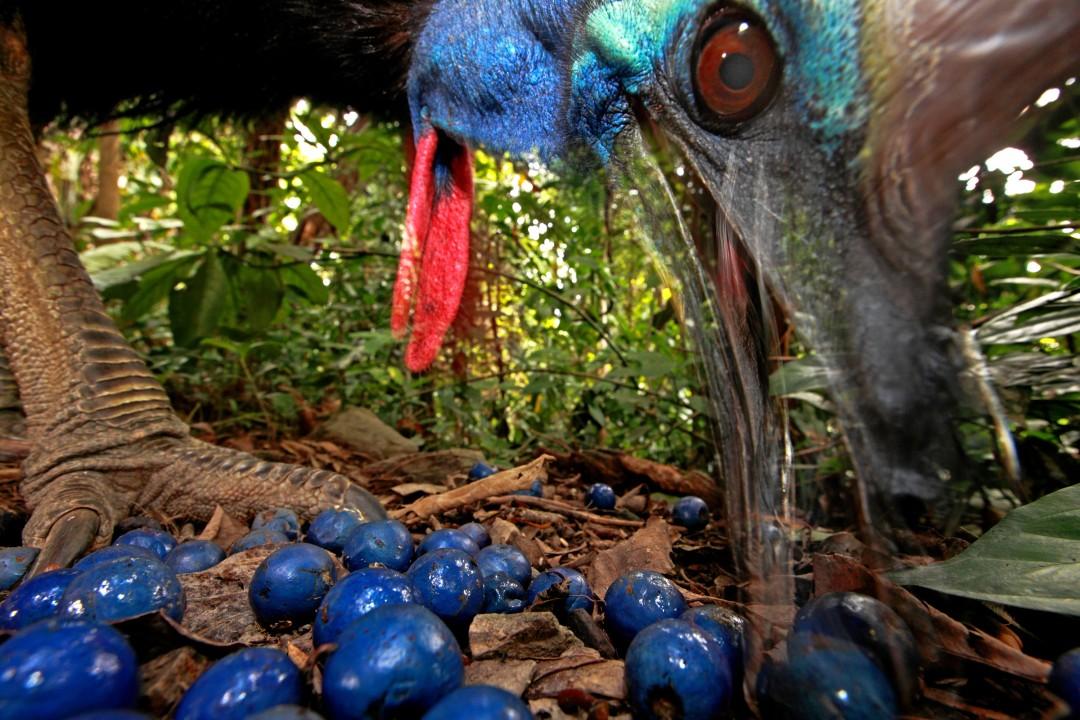
The award for 2013 World Press Photo of the Year went to Paul Hansen for his Gaza Image photograph (header image above) showing two young children who died from Israeli air strikes in the Palestinian Territories being prepared for their graves. Hansen also won the 1st prize in the singles section of the Spot News Category.

For Contemporary Issues, Maika Elan won 1st Prize Stories for "The Pink Choice" featuring gay and lesbian couples in the conservative society of Vietnam. Micah Albert won 1st prize singles for 1st Prize Singles for "At The Dandora Dump" showing a trash picker taking a break by reading a discarded book. In the Observed Portraits section, Ebrahim Noroozi took 1st Prize in Stories for "Victims of Forced Love", a story of an Iranian mother and son physically and emotionally scarred by an acid attack. Nemanja Pancic got the 1st Prize in Singles for "Little Survivor", a portrait of a newly orphaned young toddler.

In Staged Portraits, Stephan Vanfleteren earned the 1st Prize Stories for "People of Mercy", a series on Guinean people with different illnesses. Daniel Kaluuya won 1st Prize Singles for his portrait of actor Nadav Kander. In Daily Life, 1st Prize Stories went to Fausto Podavini for "Mirella", a 71-year old devoted wife to a husband stricken with Alzheimer's Disease. 1st Prize Singles was awarded to Daniel Rodrigues for "Football in Guinea-Bissau", a game being played on bare, dusty earth.


Sports Action 1st Prize Stories went to Roman Vondrous for "Cross Country Steeplechase", one of the most demanding races in the Czech Republic. 1st Prize Singles was earned by Wei Seng Chen for "Joy at the End of the Run", showing the final moment of a dangerous bull race. In General News, Alessio Romenzi got 1st Prize Stories for "Syria Under Siege", a photo story on how ordinary citizens are being affected by the current conflict in the country. Rodrigo Abd won 1st Prize Singles for "Aida", another victim in the syrian War.

For Sports Feature, 1st Prize went to Jan Grarup for "I Just Want to Dunk", documenting a group of young Somali women and their passion for basketball despite the dangers of civil unrest. For Nature, Paul Nicklen got the 1st Prize Stories for "Emperor Penguins", the curious group of birds living in the Antarctic. Christian Ziegler earned 1st Place Singles for "Southern Cassowary", a different kind of rare bird feeding of a fruit tree. In Spot News, 1st Prize Stories went to Bernat Armangue for "Gaza", a series looking back at the growing tensions between Israel and Palestine.


The full gallery of images from the 2013 World Press Photo Winners can be found on the World Press Photo website. For previous winners, have a look at the World Press Photo 2012 Winners, as well as Jodi Bieber and the Other Afghan Girl.

Saturday, September 8, 2012

Tim Flach: More Than Human


Last week's image feature on Tim Flach's action portrait of an English Springer Spaniel was so striking that it would be a shame not to feature more from the photographer. With a new publication that's about to come out, it's quite timely to have Tim Flach on this blog again, this time on his upcoming book, "More Than Human".


Tim Flach has already been featured twice on this blog for his two previous projects, Dogs Gods and Equus. With Dogs, Flach showed how thousands of years of human interaction have produced hundreds of different dog breeds, from the small Chihuahua to the large Great Dane. In Equus, the photographer again illustrated how humans have shaped these four-legged animals, from the wildest Icelandic horses to the fastest thoroughbreds.

With his latest book, More than Human, Flach expands his horizon and looks around at the thousands of other species of animals on the planet,  pointing out what makes them both different and similar to Homo sapiens. The collection contains images he took many years ago, as well as newer images he took specifically for this project.


In many of these animal portraits, Flach focuses on one action or inaction that makes these creatures similar to humans. A mother bonobo lovingly clutching on to her sleeping baby, or a great ape looking directly at the camera with soulful eyes evoke feelings of fraternity when looking at the images. These portraits are not unlike James Mollison's "James & Other Apes" which almost humanizes these animals, although Flach approaches the subject from a different point of view.

In other images, these comparisons are thrown out the window, and an objective portrait is shown. Here, the simple form of the animal, whether in movement or at rest, is highlighted. A dove taking wing shows the wondrous geometry of organic flight, while a genetically-engineered featherless chicken evokes questions of human interference in the natural world. Thus, the beauty of these portraits derive from the beauty of the animals themselves.

"What do we see when we look at creatures other than our own species? How do we interpret them? What do we want from this looking?" These are some of the questions that Flach wants to provoke in viewers. In some images, he uses the eerie human-like features of these animals to ask these unnerving inquiries. In others the animal's simply form honed from thousands of years of evolution are by themselves worthy of a portrait without questions.

While these portraits might ask the viewer, "What does it mean to be an animal?", amidst such beautiful biodiversity, it also leaves a more profound query, "What does it mean to be human?"


More images from "More Than Human" can be found on Tim Flach's website. Check out Flach's other work on Dogs and Horses featured on this blog. You can pre-order the soon-to-be released More than Human. His older publications Dogs and Equus are still available online.

Saturday, September 1, 2012

Tim Flach and the English Springer Spaniel


It's been a while since the last post featuring animal portraits, so while everyone else is enjoying their weekend, here's a picture of man's best friend hard at work. This outstanding action photo is just one of the images in the previously featured book "Dogs" by the talented Tim Flach.

Here's the image description from the PDN Photo of the Day website:

“Suddenly there’s a clattering flutter of wings, the pheasants wheel up into the sky and the hunter can get his gun to work. And who can make that happen to order? The springer spaniel, that’s who—springer by name and by nature, the dog ‘springs’ or ‘flushes’ the birds out of the undergrowth.... 

...This picture was taken on the Elveden Estate in Norfolk, England which was developed into a great shooting property in the nineteenth century by the Maharaja Dalip Singh who, in exile from his homeland in the Punjab, became passionate about raising pheasants.” -  Lewis Blackwell, text from Flach’s book, Dogs Gods.

More dogs and other furry creatures on Tim Flach's website. Be sure to check out the Reel Foto's feature on Flach's two projects: Dogs and Horses, both of which are available in the books Dogs and Equus respectively. There's also a Dogs 2013 Wall Calendar for avid dog lovers everywhere.


Wednesday, June 27, 2012

Saturday, April 21, 2012

Audrey Corregan: Obviously, Maybe, Definitely Birds


Photographs of wild and dangerous animals right in front of your face can be a scary. But what about the somewhat opposite situation? Here, the animals turn their backs to you, as if they don't want you to see them. These intriguing photographs by Audrey Corregan seem to show or hide something so obviously obvious, yet not exactly so obvious.

In her series Obviously, Corregan takes pictures of different species of birds, but only do so from the back. The images show a beautiful, but often dismissed angle of these feathered creatures. The back view also hints at something even more beautiful that is denied to the viewer. It might be birds' front view, but it might also be something even more captivating just in front of the birds and out of the viewer's sight.


Here is Audrey Corregan's website, with a few more obvious of birds from her series Obviously.

Thursday, April 19, 2012

Jonathan Griffiths: Up Close and Personal Wildlife Photography


It's been some time seen this blog has seen some animal photography, so this post should be a welcome break. The creatures here however are far from the cute and cuddly kind. This is up close and personal wildlife photography as captured by Jonathan Griffiths.


Jonathan Griffiths is a photographer who spends his time between taking portraits of people in the studio, and of animals out in the wild. He was introduced to the world of photography as a child but only very recently got his feet wet in the industry when he acquired a DSLR. Now Griffiths is famous for some of his up close wildlife images found all over the web.


The images of bears, lions and tigers up close and snarling a few feet away from the lens look too good (or too scary) to be true, but they are in fact all real. However, Griffiths states that all of the photography done with these majestic predators were done in a controlled environment. It took two or three days spending time around the carnivores in order to gain their trust and respect. In order to get them up close to his camera, the photographer would dangle little pieces of meat in front of him.

Griffiths had to wake up at 5:30 in the morning, endure freezing temperatures of 40 degrees below zero centigrade, and above all hold his ground as he took pictures of the animals in the wildlife breeding reserve.


While the illusion of dangerous wildlife in nature might have been broken now that you know that Griffiths took the pictures in a breeding refuge, the pictures are nonetheless impressive. Doubly so because the photographer is an amateur who pursued his passion and came out with a great set of photographs.

For anyone aspiring to take these kinds of picture, Griffiths' advice is too always, always bring along your camera; you'll never know that whatever is happening before you might just become a priceless moment in the future.


This is Jonathan Griffiths' website. More up close and personal wildlife photography in this section.

Friday, January 20, 2012

James Mollison: Human Like Us


It's mostly easy to brush aside sentiments about animals because they're just that: animals. Most comments about the previous post on Pieter Hugo's Hyena Men were centered more on the novelty of wild animals as pets and not so much on the treatment of the hyenas and baboons. Will it be the same for this post? Photographer James Mollison doesn't make it easy in his series "James & Other Apes" as his subjects are a little bit more human like us.


James Mollison is a portrait photographer now working for Fabrica, Benetton Group's cultural research center. The photographer has had great success in his photographic stories with "The Memory of Pablo Escobar", a collection of images about the notorious Colombian drug lord, and "Where Children Sleep", a fascinating portrait of children from different cultures and their bedrooms. His first step into the spotlight is probably his project, "James & Other Apes", a collection of close-up portraits of man's closest cousins and the subject of this blog post.

James & Other Apes came about when Mollison was watching a nature documentary and saw the differences (or rather similarities) between a human's face and that of an ape. In order to get an objective comparison, he chose to do the portraits in a passport-type head-on fashion. The results are eerily impressive (or impressively eerie).


The series includes 50 tight portraits of different apes, however the subjects in the project weren't chosen arbitrarily. Instead, Mollison traveled to different animal sanctuaries in Congo, Cameroon, Indonesia and the USA in order to take the portraits of gorillas, chimpanzees, orangutans and bonobos, all victims of illegal poaching.

The project took him four years to complete and includes a short biography of each of his named subjects.


What makes these portraits so hard to look at yet captivating at the same time? Mollison describes how he began to see different personalities in the faces of his animal subjects; just by looking at their faces, you could probably tell which ones are grumpy, which ones are jumpy, and so forth. Indeed, when it comes to apes, there is a gray area between man and animal, and this is probably what makes it hard to look at these faces without empathizing with these subjects.

There are probably more similarities than differences between humans and great apes and while it's sometimes funny to laugh at their antics or compare your friend to an ape, these pictures forces you to do the opposite and ask yourself, "What makes us human?"


If you truly want to see how much these genetic cousins can look like humans like us, check out James Mollison's website here. The entire series is available in the book James Mollison: James & Other Apes. The photographer's other books are also worthy of note: Hunger (English and Italian Edition) and James Mollison: Where Children Sleep.

 
Blogger Templates